
Comfrey Knitbone: Nature’s Time-Tested “Knitbone” for Everyday Healing
Have you ever twisted an ankle during a morning walk or woken up with that nagging back stiffness that slows you down? You’re not alone—and for centuries, people have turned to a humble garden plant for gentle, effective relief. Comfrey (Symphytum officinale), lovingly called “knitbone” or “boneset,” has been a trusted ally in supporting the body’s natural repair processes. Today, we’ll explore its fascinating history, traditional wisdom, modern research-backed benefits, and—most importantly—how to use it safely at home. Let’s discover how this resilient herb can support your body’s innate healing power, one application at a time.
History of Comfrey (Knitbone)
Comfrey’s story stretches back over 2,000 years. Native to Europe and parts of Asia, this fast-growing member of the borage family earned its scientific name Symphytum from the Greek words meaning “to grow together” and “plant.” Early records show it was cultivated as a healing herb as far back as 400 BC by the Greeks and Romans. They prized it for stopping heavy bleeding, treating bronchial issues, and mending wounds and fractures. Poultices made from its leaves and roots were a go-to remedy for external injuries, while teas addressed internal concerns.
By medieval times, comfrey had become battlefield medicine. European herbalists applied it to soldiers’ wounds, broken bones, and trauma. English herbalist John Gerard (1545–1612) noted its “slimie substance” could ease back pain, while Nicholas Culpeper recommended it for everything from inward wounds and bruises to gout, hemorrhoids, and even knitting together severed tissues. Across the Atlantic, Native Americans recognized its power and incorporated it into their healing traditions. It was even grown as livestock fodder and a nutrient-rich garden addition—proof of its deep connection to everyday life and resilience.
In modern herbalism, comfrey knitbone continues to be valued for its remarkable ability to support recovery and ease discomfort.
Key Takeaway: Comfrey’s nickname “knitbone” isn’t folklore—it reflects centuries of observed tissue-supporting action.
Traditional Uses That Still Resonate Today
Historically, comfrey was used both externally and internally, always with reverence for its mucilaginous, soothing qualities. Traditional applications included:
- Poultices and compresses for sprains, bruises, fractures, and joint pain—applied directly to “knit” tissues back together.
- Ointments and washes for skin wounds, ulcers, mastitis, and hemorrhoids.
- Internal teas or decoctions (in earlier eras) for respiratory support, digestive ulcers, and reducing inflammation from within.
These uses stemmed from comfrey’s rich content of allantoin (a compound that promotes healthy cell proliferation) and rosmarinic acid (a natural anti-inflammatory). People saw it as food-as-medicine in the truest sense—God-made nourishment for the body’s repair systems.
Modern Research: Evidence-Based Support for Topical Use
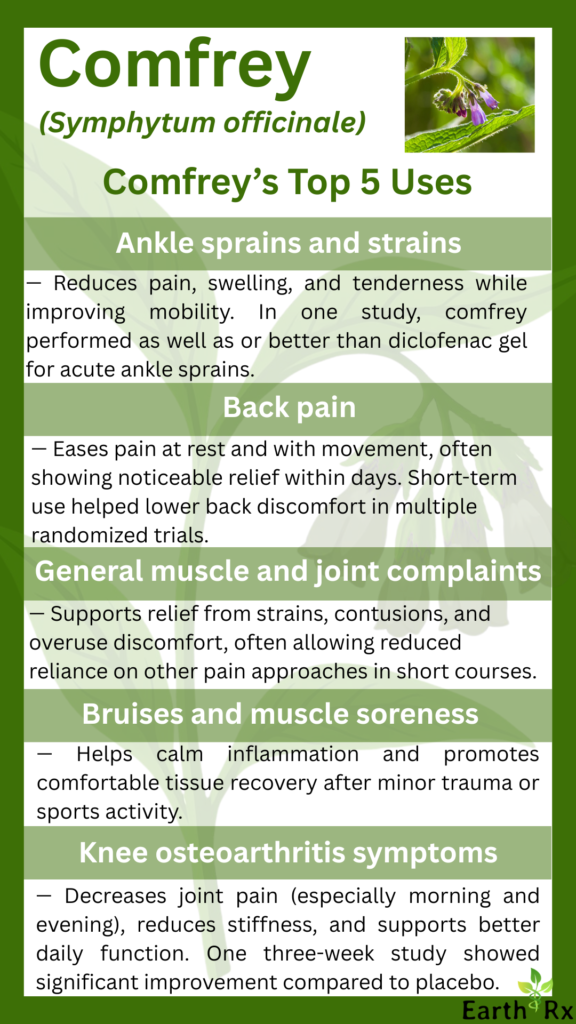
Fast-forward to today: science has validated many traditional insights—especially for topical applications. Multiple randomized controlled trials (RCTs) confirm comfrey root extract creams and ointments help relieve pain, reduce swelling, and improve mobility in everyday issues like ankle sprains, back pain, and knee osteoarthritis. One landmark study showed comfrey ointment performed as well as (or better than) diclofenac gel for acute ankle sprains. Another double-blind trial found it significantly eased painful knee osteoarthritis over three weeks.
A 2013 scoping review of 26 studies (including 13 RCTs) reported consistent benefits for ankle distortion, back pain, abrasion wounds, and osteoarthritis—with very few adverse events when used topically on intact skin. Preclinical research highlights allantoin’s role in encouraging new skin-cell growth and rosmarinic acid’s soothing effects on inflammation.
Pro Tip: These benefits shine brightest when comfrey supports your body’s natural healing after minor strains or bruises—not as a cure-all, but as a compassionate partner in recovery.
Important Safety Notes: Honoring the Plant’s Power
Comfrey contains naturally occurring pyrrolizidine alkaloids (PAs) that can stress the liver when taken internally or used long-term. For this reason, the FDA recommends against any oral comfrey products, and major health authorities limit it to external use only. Cases of liver concerns have been linked to high-dose or prolonged internal consumption—never a risk we want to take.
Safe topical use is well-supported in studies when guidelines are followed: apply only to unbroken skin, for short periods (up to 3–6 weeks maximum in most guidance), and in regulated formulations with limited surface area. It is not for pregnant or nursing individuals, children under 3, or anyone with liver or kidney concerns. Always patch-test first on a small area of skin.
Symptoms to watch for with topical use (rare when used properly on intact skin):
- Mild skin reactions such as redness, itching, burning sensation, or rash at the application site.
- In very rare cases of allergic sensitivity: hives, swelling, or difficulty breathing—stop use immediately and seek medical help.
For any internal use (strongly discouraged): Watch for signs of liver stress, including nausea, upper stomach pain, unusual tiredness, loss of appetite, dark urine, clay-colored stools, or yellowing of the skin or eyes (jaundice). If these appear, stop everything and contact a healthcare provider right away.
Drug Interactions: Topical comfrey has no well-documented interactions, but avoid combining with other liver-stressing medications or herbs out of caution. If you take any prescription drugs, chat with your healthcare provider first—we’re all about empowered, informed choices.
Key Takeaway: Listen kindly to your body. Short-term, mindful topical use on intact skin allows most people to benefit safely while minimizing risk.
Dosing Guide: Simple, Safe, and Effective
Focus on topical only—oral use is not recommended.
- Creams or ointments (standardized comfrey root extract): Apply a thin layer 3–4 times daily to the affected area for up to 3 weeks.
- General guideline: Follow product labels or practitioner advice; many clinical trials used preparations delivering under 100 mcg of PAs per day.
- Duration: Short courses only. Stop and reassess after 10–21 days.
Key Takeaway: Less is more. When used mindfully, comfrey offers powerful support without overstepping safety boundaries.
Practical Ways to Use Comfrey at Home
Here are gentle, time-tested methods to welcome comfrey into your self-care routine:
- Fresh Leaf Poultice – Chop a handful of fresh (or rehydrated dried) leaves, mix with a little warm water and flour or clay into a paste. Wrap in cloth and apply to bruises, sprains, or sore joints for 20–30 minutes. Repeat as needed.
- Infused Oil – Fill a jar with dried comfrey leaves, cover with olive or coconut oil, and let steep in a sunny window for 2–3 weeks (or gently heat in a double boiler). Strain and use as a massage oil for muscles.
- Healing Salve – Melt 1 oz beeswax into 1 cup comfrey-infused oil, pour into tins, and let cool. Apply sparingly to support skin repair and ease discomfort.
- Compress – Steep dried leaves in hot water, strain, soak a cloth in the warm tea, and lay over the area for soothing relief.
Pro Tip: Grow your own comfrey in a dedicated garden spot—it’s hardy, prolific, and a wonderful addition to compost too!
Frequently Asked Questions About Comfrey
Is comfrey safe to use on skin?
Yes, when applied only to unbroken skin in small amounts for short periods (up to 3–6 weeks). Always do a patch test first and stop if any irritation occurs.
Can you take comfrey internally?
No. Health authorities, including the FDA, strongly advise against any internal or oral use due to potential liver risks from pyrrolizidine alkaloids.
How long can you use comfrey ointment?
Most studies and guidelines support safe topical use for up to 3 weeks (some extend to 6 weeks with caution). After that, take a break and reassess with your healthcare provider.
What are the side effects of comfrey?
For topical use on intact skin, side effects are uncommon but may include mild redness, itching, burning, or rash at the site. Rare allergic reactions could involve hives or swelling—stop use and seek care if this happens. Internal use carries serious liver risks and is not recommended.
Is comfrey better than arnica for pain relief?
Both herbs are helpful in different ways. Comfrey excels at supporting tissue repair and “knitting” bruised or strained areas, while arnica is often favored for bruising and muscle soreness. Many people use them together for well-rounded comfort after minor injuries.
Your Next Step Toward Natural Healing
Comfrey reminds us that true wellness often grows right in our own backyard. By honoring its history, respecting modern safety guidelines, and using it topically with care, you give your body a natural boost toward feeling strong, mobile, and resilient again.
Start small: plant a comfrey patch, make a simple poultice after your next garden workout, or pick up a trusted topical cream. Listen to your body, consult your healthcare provider when needed, and celebrate the gentle power of plants. You’ve got this—here’s to moving with more ease and joy every day.
References
- Staiger C. Comfrey root: from tradition to modern clinical trials. Wien Med Wochenschr. 2013.
- Frost R, et al. A critical scoping review of external uses of comfrey (Symphytum spp.). Complement Ther Med. 2013.
- Grube B, et al. Efficacy of comfrey root extract ointment in painful osteoarthritis of the knee. Phytomedicine. 2007.
- D’Anchise R, et al. Comfrey extract ointment vs diclofenac gel for ankle sprains. Arzneimittelforschung. 2007.
- WebMD. Comfrey: Uses, Side Effects, and More.
- Drugs.com. Comfrey Uses, Benefits & Dosage.
- Mei N, et al. Metabolism, genotoxicity, and carcinogenicity of comfrey. J Environ Sci Health C Environ Carcinog Ecotoxicol Rev. 2010.
- Mountain Rose Herbs. Comfrey Monograph: Benefits, Uses, & Controversy.
- Comfrey root: from tradition to modern clinical trials
Always consult a qualified healthcare professional before beginning any new herbal regimen, especially if you have health conditions or take medications.